German American Bund
Before examining Bund camps themselves, however, it is necessary to understand the origins of organized American Nazism. The Friends of New Germany emerged from earlier German-American nationalist organizations, particularly the Free Society of Teutonia, founded in Chicago in 1924 by Fritz Gissibl. Initially centered on ethnic nationalism among German immigrants, Teutonia increasingly aligned itself with the Nazi Party and was formally absorbed into its overseas structure by 1932. Then organizational activity shifted toward New York City, where German-American institutional networks were well established, while remaining strong in the Midwest. In 1933, with the approval of Rudolf Hess, a leading member of the Nazi party in Germany, the group reorganized as the Friends of New Germany in an effort to centralize pro-Nazi efforts in the United States. Yet Adolf Hitler worried that overt affiliation with the Nazi Party would provoke anti-Nazi sentiment in America and eventually ordered the organization disbanded. Although the Friends of New Germany struggled to build a lasting institutional presence, including unsuccessful attempts to establish youth camps, the organization laid important groundwork for the later German American Bund and helped shift the movement’s center toward New York City and the United German Societies of Greater New York.
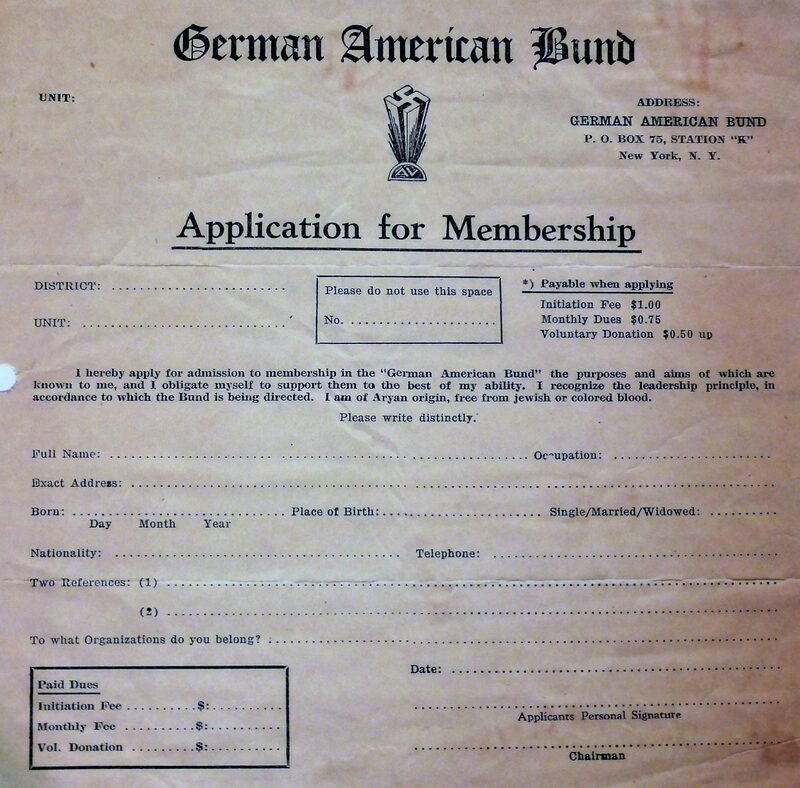
In 1936, the German American Bund emerged as the successor to the Friends of New Germany. Founded in Buffalo, New York, the Bund sought to present itself as both patriotic and ethnically German while advancing National Socialist ideology in the United States. At its height in 1937, the organization claimed approximately 30,000 members. According to Bund leader Fritz Kuhn, “The Bund [was] American in its inception and in its field of endeavor, German in its idealism and character.” Unlike the Friends of New Germany, the Bund placed far greater emphasis on creating durable institutions, especially youth programs and summer camps.
Fritz Kuhn led the Bund from its founding in 1936 until his arrest in 1939. Kuhn portrayed himself as a decorated German war veteran who witnessed the economic consequences of the Treaty of Versailles, like hyperinflation, and participated alongside Hitler in the 1923 Beer Hall Putsch. During the 1920s, Kuhn moved to Mexico before immigrating to the United States in 1928, becoming a naturalized citizen in 1934. He later claimed to have worked at a Ford factory in Detroit prior to entering Bund leadership. Historians such as Sander Diamond, however, question several aspects of Kuhn’s personal narrative, arguing there is little evidence linking him either to the Beer Hall Putsch or to employment at Ford. One possible explanation is that Kuhn deliberately misrepresented his employment history to strengthen his standing within Midwestern American Nazi networks, which frequently drew leadership from current and former Ford employees. However, it is equally possible that the inconsistency stems from conflicting or inaccurate historical sources rather than intentional fabrication.
From the beginning of his leadership, Kuhn attempted to make National Socialism appear, or perhaps be, compatible with American values in order to broaden the Bund’s appeal and “convert our American fellow citizens into true friends of the present-day Germany.” He recognized both the lingering anti-German sentiment that remained after World War I and the desire of recent German immigrants to maintain cultural connections with Germany. Kuhn therefore focused particularly on immigrants who had arrived after 1919 and who may have experienced the economic and political consequences of post War life in Germany more directly. Kuhn and therefore the Bund placed youth education at the center of its long-term strategy, viewing children as essential to securing the future of National Socialism in the United States. Within the context of the rapidly expanding American summer camp movement, Kuhn and the Bund established a network of summer camps across New England, the Mid-Atlantic, and the Midwest.